Sunday, 20 December 2020

Presenting Bare Assertions As Supporting Argument: Sinclair

Fawcett (2010: 199):
Sinclair, who was one of Halliday's closest colleagues at the time, published in 1972 an introduction to systemic grammar in which he included all of the following as criteria for recognising units:
a) the guidance given by similar or different meanings (i.e., semantic criteria); 
b) the internal details or componence of structure; 
c) the external details, or syntax of structures. (Sinclair 1972:23)
Since the second and third criteria are often in conflict, this list should perhaps be taken as an indication of the order of Sinclair's preferences — and we note that Halliday's standard criterion is relegated to third place. In the present theory we go one step further, as in Fawcett (1974-6/81:10), and exclude the last criterion altogether. Sinclair does not explain what he intends by "semantic criteria", but at the very least his wording allows for the possibility that semantics influences syntax in the way described at the start of Section 10.2.1.


Blogger Comments:

[1] To be clear, Sinclair's criteria, from 1972, are not supported by reasoned argument.

[2] To be clear, as previously demonstrated, the criteria that Fawcett rejects, (c), are the those that take the view 'from above', and so are consistent with SFL as a functional theory, whereas the criteria that Fawcett accepts, (b), are those that take the view 'from below', and so are inconsistent with SFL as a functional theory.

[3] To be clear, in SFL Theory, semantics does not "influence" syntax, semantics is realised by lexicogrammar. That is, they are in a relation of intensive identity, as two levels of symbolic abstraction, Value and Token, having originated as one, and dissociated in grammatical metaphor (Halliday & Matthiessen 1999: 26).

Friday, 18 December 2020

Misrepresenting Halliday (1963) On Class

Fawcett (2010: 199):
So far as I am aware, Halliday has never shown why facts such as those described above are not counter-examples to his claim. However, he has commented in an interesting manner on a partly similar set of examples in Halliday (1963/76). Here he addresses the fact that a nominal group such as this morning functions as an Adjunct just as naturally as it functions as a Subject or Complement (and far more frequently). Here he reaches the conclusion that
this morning "clearly resembles other nominal groups (the morning, this man, etc.) rather than other adverbial groups (quickly, on the floor, etc.) and this can be allowed to determine its primary syntactic assignment [my emphasis]. (Halliday 1963:6)
How does this acknowledgement of the facts affect his view of the criteria for recognising units? The answer is that it appears to remain unchanged, on the evidence of the criteria used for recognising units in IFG. But if the criterion of the internal structure applies in the above case, one asks, why not in all cases?


Blogger Comments:

[1] To be clear, as the previous post demonstrates, these "facts" are misunderstandings on Fawcett's part, and so do not constitute counter-examples to the criteria used in SFL Theory for classifying units.

[2] This is very misleading indeed. As demonstrated in a previous post, this highly selective excerpt from Halliday (1963) is concerned with explaining the alternative criteria for classifying units that, unlike Fawcett, he himself does not adopt. Halliday (2002 [1963]: 95-7):
I have assumed, for the purpose of the main points made in the paper, that this category of “class” is to be defined syntactically. By this I mean that the concept is introduced into the description of a language in order to bring together those sets of items that have the same potentiality of occurrence; in other words, sets of items which are alike in the way they pattern in the structure of items of higher rank. Thus, to take a typical instance from grammar, we may have morpheme classes defined by word structure, each such class being one set of morphemes having a given value in the structure of words: as, for example, the morphemes of inflexion in Latin nouns. Likewise we might have word–classes defined by group structure, or clause–classes by sentence structure.
This use of the term “class”, to name a category defined in some way by its relationship to a higher structure, is by no means universal in linguistics; but it would probably be granted that some such category is necessary to linguistic description whatever name we choose to adopt for it. Syntactic classification (sometimes referred to as “functional classification”, in what is perhaps a rather misleading opposition of “form” and “function”) is a central feature of linguistic method, and one which it seems appropriate to discuss in the present context.
The alternative to this use of the term “class” is to consider morphological classification. Here “class” would be the name given to a set of items which are alike in their own structure: that is, in the way that they themselves are made up of items of lower rank. A word–class would then be a set of words having a certain similarity in their own formation out of morphemes. In this usage there are no morpheme classes, since “morpheme” is the name given to the smallest unit in grammar, which by definition has no structure: its relation to items abstracted at other levels, such as phonemes, is not one of structure, but involves the interrelation of different dimensions of abstraction.
It is important to notice that this is in the first instance a terminological alternative, not necessarily implying a different theory. It is not the case that the linguist has to choose between two different kinds of classification, the syntactic and the morphological; he has in fact to recognise both kinds of likeness. Moreover, the sets of items identified on these two criteria often coincide: we may recognize a syntactic class “noun”, for example, defined as “that class of word which operates as head of a nominal group”, and find that the items grouped together on this criterion will be the same set as would be grouped together on a morphological criterion such as “that type of word which is made up of a stem morpheme followed by a morpheme of case and a morpheme of number”.1 Indeed other things being equal, it is usually accepted as desirable that the two should coincide: when the linguist is faced, as he often is, with a choice between two descriptions, both theoretically valid and both accounting for the facts, one in which the two assignments coincide and one in which they do not, he will normally, and “intuitively”, choose the former. For example, groups in English such as this morning operate in clause structure both as Adjunct, as in “I came this morning”, and as Subject (or Complement), as in “this morning promises to be fine” (or “I’ve set this morning aside for it”). The syntactic class defined by operation as Adjunct is the adverbial group; that defined by operation as Subject or Complement is the nominal group. Syntactically, therefore, this morning could be assigned to either or both of these classes. Morphologically, however, it clearly resembles other nominal groups (the morning, this man, etc.) rather than other adverbial groups (quickly, on the floor, etc.), and this can be allowed to determine its primary syntactic assignment.
There are, however, clear instances where syntactically defined sets do not coincide with morphologically defined sets; and it would probably be generally agreed that, whatever the status accorded to the latter, the former cannot be ignored. Syntactic likeness must be accounted for. Moreover, even where the two sets do coincide, the criteria on which they have been established, and therefore their theoretical status, is different; and it is desirable that they should not be called by the same name. It seems to me appropriate that the term “class” should be reserved for the syntactic set (the morphological set may then be referred to as a “type”), and I propose to adopt this usage here. It is also true, in my opinion, that the class thus defined, the syntactic set, is crucial to the whole of linguistic theory, since it is required to give meaning to the basic concepts of “structure” and “system”; whereas the type, or morphological set, is more a descriptive convenience whose theoretical implications are largely internal to itself.
In the remaining sections of this paper, therefore, I should like to discuss two aspects of the syntactically defined set, which I shall refer to henceforward simply as the “class”.

Tuesday, 15 December 2020

Problems With Fawcett's Critique Of Halliday's Criterion For Classifying Groups

Fawcett (2010: 198-9):
What reasons could Halliday have had for setting up classes of unit on the basis of their potential for operation in the unit above? The most likely is the generalisation that nominal groups tend to occur as the Subjects and Complements of clauses. 
The first problem for his criterion is the fact that nominal groups also occur very frequently as elements of other unitsparticularly in prepositional groups. Such cases challenge his criterion, because it requires the higher unit to be 'above' the current unit on the 'rank scale', and in such cases it is at the same 'rank'. 
A second problem for Halliday's criterion, as Butler points out (1985:33), is the fact that an expression such as very clever is classified by Halliday as a type of "nominal group". The problem is that, although it occurs naturally as a Complement, it does not occur (except in quotation marks) as a Subject. It is therefore a counter-example to the claim that nominal groups are defined by their potential to operate as both Subject and Complement. While Halliday himself points out this inconsistency (IFG p. 80), the fact that he does so does not weaken its force as an argument against his general claim. 
And the problems for his claim increase when we also take into account the fact that a unit such as very clever can also function as the modifier in a nominal group (e.g., a very clever cat). Is it still a nominal group in such a case, in IFG terms? It appears not, since on p. 192 it is analysed as a case of "submodification". But there is no explanation of this inconsistency. 
These facts present no problem for the model outlined here, because it assumes that it is a natural characteristic of language that two units with the same internal structure should be able to fill two or more elements of other units (as is demonstrated in the summary of what units can fill what elements in Appendix B).


Blogger Comments:

[1] To be clear, Halliday's criterion derives from the functional perspective of taking the view 'from above', and from the broader notion that a functional grammar incorporates the natural relation between semantics and grammatical form, as between participant and noun (expanded as nominal group), and between process and verb (expanded as verbal group). Halliday (1994: xviii):


Halliday & Matthiessen (2014:363) relate group and phrase classes to both the experiential and modal structures of the clause:

[2] To be clear, Fawcett here takes the view 'from below' (nominal group) instead of the (SFL) view 'from above' (clause function). The question is whether nominal groups are distinguished from other groups in that they congruently realise Subject, Complement or a participant rôle.

[3] To be clear, in SFL Theory, nominal groups do not "occur as elements of prepositional groups". Nominal groups are constituents of prepositional phrases, and they realise the Complement/Range element of phrase structure. Where a group is an expanded word, a phrase is a contracted clause, with its preposition serving as minor Process/Predicator. The reason why group and phrase are located at the same point on the rank scale, is that both realise clause rank functions. On Halliday's model, it is the prepositional phrase that realises a clause rank function — Adjunct/circumstance rôle — not its constituent nominal group.

[4] To be clear, Butler makes the same error as Fawcett, in taking the view 'from below' (nominal group) instead of the (SFL) view 'from above' (clause function). The question is whether nominal groups are distinguished from other groups in that they congruently realise Subject, Complement or a participant rôle. It is because Attributes/Complements are realised by groups like very clever, over sixty, a slow learner that all three variants can be classified as nominal groups.

[5] This is misleading. The exceptionality here is the fact that the functions of Attribute and Subject cannot conflate. Halliday (1994: 80):

[6] To be clear, there is no inconsistency here. Here again Fawcett takes the view 'from below' (form) instead of the (SFL) view 'from above' (function). The wording very clever as in a very clever cat is a unit in Fawcett's Cardiff Grammar, but not in SFL Theory. In SFL theory, the unit is a very clever cat, a nominal group, and identified as such by the fact that, like other nominal groups, it congruently realises Subject, Complement and participant rôles of clause rank structures.

[7] To be clear, on the one hand, these are not "facts"; see [2] to [6] above. On the other hand, the view 'from above' does not rule out the possibility "that two units with the same internal structure should be able to fill two or more elements of other units" as demonstrated by the fact that a prepositional phrase can serve in either a circumstantial or participant rôle at clause rank:

Sunday, 13 December 2020

Why Fawcett Rejects Halliday's Criteria For Classes Of Unit

Fawcett (2010: 197-8):
There is a crucial difference, therefore, between the theoretical positions taken on this matter in the Sydney and the Cardiff Grammars. Moreover, there are many other systemic linguists who have differed from Halliday on this key matter, as we shall now see.
Butler (1985:33-5) provides a valuable discussion of several of the problems with Halliday's concept of 'class', referring to some of the key contributions to the literature that it has generated. He points out that "certain other systemicists" — including Huddleston (1966/81), Hudson (1967/81) and myself (Fawcett 1974-6/81) — had by then abandoned Halliday's criterion of the potential for operation in the unit above it on the 'rank scale', in favour of the criterion of "the internal structure of units".
This leads to the question of why I and others should have abandoned this central tenet of Halliday's theory. My own answer — and I cannot speak for Huddleston and Hudson — is that my experience of building models of English syntax (for use in both generating and describing text) has taught me that the model become [sic] far more insightful, when I treat the internal structural patterns of a unit as the defining ones (for the reasons given in Section 10.2.1). One must operate with either internal criteria or external criteria (the latter being operation in the unit next above on the 'rank scale'), because the two are often in conflict. I find that the descriptive facts of natural texts in English and other languages provide just too many clear examples where it distorts the facts to categorise them in terms of their operation in a higher unit, and where it is insightful to categorise them in terms of their internal syntactic-semantic structure.


Blogger Comments:

[1] This is misleading. On the one hand, the "many" systemic linguists are four in number, namely:

  • Fawcett himself,
  • Christopher Butler, an advocate of Fawcett's Cardiff Grammar,
  • Richard Hudson, who was Halliday's research assistant (1964-70) and is not a systemic linguist (his theory is 'Word Grammar'), and
  • Rodney Huddleston, who was Halliday's student (1961-3) and research assistant (1964-7), and is not a systemic linguist.
On the other hand, here Fawcett combines the logical fallacy known as argumentum ad populum ('many other systemic linguists') with the logical fallacy known as argumentum ab auctoritate, whereby authorities are cited instead of their arguments.

[2] To be clear, Fawcett does not provide any reasoned arguments from Butler (1985: 33-5) as to why Hudson and Huddleston see Halliday's concept of 'class' as problematic.

[3] To be clear, this is but bare assertion ("far more insightful") unsupported by reasoned argument.

[4] This is misleading. As previously demonstrated, Fawcett's Section 10.2.1 merely outlines, in general terms, the concept of 'class of unit' in the Cardiff Grammar. It does not provide any reasons as to why classifying units on the basis of structure is "far more insightful".

[5] To be clear, in SFL Theory, this corresponds to taking the view 'from below' ("internal criteria") or the view 'from above' ("external criteria"). In Systemic Functional Linguistics priority is given to the view 'from above': to system over structure, to function over form. Fawcett's view is inconsistent with the principles of SFL Theory.

[6] To be clear, if the two are often in conflict, then the conflict is between taking Halliday's systemic-functional perspective and taking Fawcett's structural-formal perspective.

[7] To be clear, this is another bare assertion unsupported by reasoned argument.

[8] This is misleading, because it is untrue. In Fawcett's model, Figure 4 (p36), structure is syntactic (formal), but not semantic (meaning):

Friday, 11 December 2020

Misrepresenting Fawcett On Class Of Unit

Fawcett (2010: 197):
Halliday takes a very different approach to the criteria for recognising a 'class of unit'. While the criterion used here is the unit's internal structure (together with semantic criteria, as described in Section 10.2.1), for Halliday the criterion is the unit's ability to fill elements of units at the 'rank' next above it on the 'rank scale' (as we saw in Section 2.3 of Chapter 2). Thus Halliday's definition of 'class of unit' is dependent — like so much else in his theory — on the concept of the 'rank scale'.
It is interesting to note that Halliday later (1963/76) introduced to the theory a concept that he termed "type". It was introduced as a complement to 'class', in a sense that is exactly equivalent to the concept of 'class of unit' as it is used here. In other words, in Halliday (1963/76) a unit's 'type' is defined in terms of a unit's internal structure. Interestingly, while Berry's introduction to the theory gives a clear account of the difference between this concept and Halliday's "Categories" sense of 'class of unit' (1975:76-7, 124-6), Berry makes no further use of it, and the concept has not been used in most later accounts of the theory. Thus it is not mentioned by Halliday in either "Systemic theory" or IFG, nor by Matthiessen (1995). 
Moreover, in both IFG and Matthiessen (1995) units continue to be defined in the "Categories" manner. Halliday is clearly using this criterion when deciding to treat very lucky in You're very lucky as a nominal group (p. 194 of IFG), and Matthiessen emphasises the correlation between "grammatical units of different classes" and their "functional potential [in the unit above]" (Matthiessen 1995:22).


Blogger Comments:

[1] To be clear, this is not misleading, because it is true.

[2] To be clear, this is misleading, because it is untrue. As previously demonstrated, Fawcett's classifies his units differently according to the syntagmatic structure of each unit ('from below'), not on the basis of the meaning it realises ('from above'). For example, as previously discussed, he classifies the groups over sixty and very clever differently — as quantity vs quality group — despite the fact that both congruently realise the same meaning: Attribute.

[3] To be clear, this is slightly misleading. It is not so much that the 'definition' of class of unit is dependent on a rank scale, but that the rank scale provides a grammatical means of modelling the natural relation between meaning (e.g. thing) and grammatical form (e.g. noun). See, for example, Halliday & Matthiessen (1999: 15, 18ff).

[4] This is very misleading indeed. Halliday (1963) only outlines this alternative method in order to identify it as the approach he is not taking — which is why it is not taken up later by Berry, Halliday or Matthiessen. Halliday (2002 [1963]: 95-7):

I have assumed, for the purpose of the main points made in the paper, that this category of “class” is to be defined syntactically. By this I mean that the concept is introduced into the description of a language in order to bring together those sets of items that have the same potentiality of occurrence; in other words, sets of items which are alike in the way they pattern in the structure of items of higher rank. Thus, to take a typical instance from grammar, we may have morpheme classes defined by word structure, each such class being one set of morphemes having a given value in the structure of words: as, for example, the morphemes of inflexion in Latin nouns. Likewise we might have word–classes defined by group structure, or clause–classes by sentence structure.
This use of the term “class”, to name a category defined in some way by its relationship to a higher structure, is by no means universal in linguistics; but it would probably be granted that some such category is necessary to linguistic description whatever name we choose to adopt for it. Syntactic classification (sometimes referred to as “functional classification”, in what is perhaps a rather misleading opposition of “form” and “function”) is a central feature of linguistic method, and one which it seems appropriate to discuss in the present context.
The alternative to this use of the term “class” is to consider morphological classification. Here “class” would be the name given to a set of items which are alike in their own structure: that is, in the way that they themselves are made up of items of lower rank. A word–class would then be a set of words having a certain similarity in their own formation out of morphemes. In this usage there are no morpheme classes, since “morpheme” is the name given to the smallest unit in grammar, which by definition has no structure: its relation to items abstracted at other levels, such as phonemes, is not one of structure, but involves the interrelation of different dimensions of abstraction.
It is important to notice that this is in the first instance a terminological alternative, not necessarily implying a different theory. It is not the case that the linguist has to choose between two different kinds of classification, the syntactic and the morphological; he has in fact to recognise both kinds of likeness. Moreover, the sets of items identified on these two criteria often coincide: we may recognise a syntactic class “noun”, for example, defined as “that class of word which operates as head of a nominal group”, and find that the items grouped together on this criterion will be the same set as would be grouped together on a morphological criterion such as “that type of word which is made up of a stem morpheme followed by a morpheme of case and a morpheme of number”. Indeed other things being equal, it is usually accepted as desirable that the two should coincide: when the linguist is faced, as he often is, with a choice between two descriptions, both theoretically valid and both accounting for the facts, one in which the two assignments coincide and one in which they do not, he will normally, and “intuitively”, choose the former. For example, groups in English such as this morning operate in clause structure both as Adjunct, as in “I came this morning”, and as Subject (or Complement), as in “this morning promises to be fine” (or “I’ve set this morning aside for it”). The syntactic class defined by operation as Adjunct is the adverbial group; that defined by operation as Subject or Complement is the nominal group. Syntactically, therefore, this morning could be assigned to either or both of these classes. Morphologically, however, it clearly resembles other nominal groups (the morning, this man, etc.) rather than other adverbial groups (quickly, on the floor, etc.), and this can be allowed to determine its primary syntactic assignment.
There are, however, clear instances where syntactically defined sets do not coincide with morphologically defined sets; and it would probably be generally agreed that, whatever the status accorded to the latter, the former cannot be ignored. Syntactic likeness must be accounted for. Moreover, even where the two sets do coincide, the criteria on which they have been established, and therefore their theoretical status, is different; and it is desirable that they should not be called by the same name. It seems to me appropriate that the term “class” should be reserved for the syntactic set (the morphological set may then be referred to as a “type”), and I propose to adopt this usage here. It is also true, in my opinion, that the class thus defined, the syntactic set, is crucial to the whole of linguistic theory, since it is required to give meaning to the basic concepts of “structure” and “system”; whereas the type, or morphological set, is more a descriptive convenience whose theoretical implications are largely internal to itself.
In the remaining sections of this paper, therefore, I should like to discuss two aspects of the syntactically defined set, which I shall refer to henceforward simply as the “class”.

Tuesday, 8 December 2020

Fawcett's Notion Of 'Conceptual' Representations In A Belief System

Fawcett (2010: 196-7):
In the present theory, then, the decision to recognise a possible class of unit is dependent on the recognition of the semantic similarities between configurations of functionally motivated elements, based on the comparison of large numbers of instances in texts of potential members of that unit. However, we should also note that it is not the case that a syntactic unit always corresponds in a one-to-one manner to the event or object etc. to which it refers, i.e., to its equivalent 'conceptual' representation in the belief system. In a slowly evolving construct such as a natural human language (as opposed to an artificial language such as a logic) we should expect to find quite frequent cases of the lack of a one-to-one fit of this type. (For some typical cases such as that of 'nominalisation', see Section 10.2.10.)


Blogger Comments:

[1] This is misleading. Fawcett classifies units by their structural similarities ('from below'). In Fawcett's model (Figure 4), such structures are syntactic, not semantic.

[2] To be clear, Fawcett here refers to the model given in Figure 12 (p210):


As can be seen, Fawcett's model reduces all meaning to ideational meaning, and reinstates the meanings of language (event, object) outside language. This is fundamentally inconsistent with the epistemological assumptions on which SFL Theory has been constructed. Halliday & Matthiessen (1999: 2-3):

In modelling the meaning base [i.e. ideational semantics] we are building it 'upwards' from the grammar, instead of working 'downwards' from some interpretation of experience couched in conceptual terms, and seen as independent of language. We contend that the conception of 'knowledge' as something that exists independently of language, and may then be coded or made manifest in language, is illusory.

Sunday, 6 December 2020

Confusing Experiential With Logical Structure And Misconstruing Form As Function

Fawcett (2010: 196):
In many theories of syntax there is an assumption that each unit has an element that is obligatorily present (often called the 'head'). This reflects the traditional assumption that a unit is essentially the 'expansion' of a word — a concept which is replaced here by recognising the fact that each element realises one aspect of the unit's meaning, as explained in Section 10.2.1. But among formal grammarians — i.e., those who are influenced by formal language theory (i.e., the theory of 'formal' languages) — there is a tendency to transfer the characteristics of formal languages to natural languages, and so to construct theories for parsing natural languages on the basis of such assumptions (e.g., 'head-driven parsers'). However, the data of natural language texts suggest that such concepts express strong tendencies rather than absolute rules.
On the other hand, the concept of an element that is typically present in a given class of unit is useful (e.g., when the theory of syntax is to be used by a parser), and on those occasions when we need to refer to such an element we shall call it, informally, the pivotal element of the unit. Examples of nominal groups that have no heads include the very rich and five in Give me five (see Fawcett in press for the reasons for these analyses). And for a discussion of the Main Verb as the pivotal element of the clause, see Section 10.4.2.


Blogger Comments:

[1] To be clear, Fawcett's claims here are that

  • his model replaces logical structure with experiential structure, and
  • only experiential structure "recognises the fact that each element realises one aspect of the unit's meaning".
On the first claim, it will be demonstrated that Fawcett confuses logical and experiential structure; see below. On the second claim, logical structure construes meaning in terms of the relation of modification, which thus also "recognises the fact that each element realises one aspect of the unit's meaning".

[2] To be clear, the structural element that is "typically" present is the Head, since this is the element that is optionally modified. That is, on the one hand, Fawcett rejects logical structure, while on the other, he uses one of its elements, the Head, and renames it the Pivot.

[3] To be clear, these nominal groups do have Head elements (logical structure); what they do not have are Thing elements (experiential structure). That is, Fawcett's model confuses logical and experiential structure.


[4] To be clear, 'Fawcett in press' (Functional Syntax Handbook) is still unpublished, 20 years after the first edition of this book.

[5] To be clear, on the one hand, this unwittingly construes the clause as a logical structure, since 'Pivot' is demonstrably Fawcett's term for 'Head'; see above. On the other hand, it misconstrues a class of form (main verb) as an element of function structure.

Friday, 4 December 2020

Classifying Groups By Their Internal Structure

Fawcett (2010: 196n):
⁶ Let me give an example of the use of these criteria when introducing a new class of unit. The quantity group was only introduced to the present description of English syntax when detailed studies of this area of the grammar showed that it could not reasonably be handled in terms of an existing unit, such as the quality group. In other words, it became clear that there are units with 'quantities' as their pivotal element (e.g., over sixty) as well as groups with 'qualities' as their pivotal element (e.g., quite clever) — and that the elements of structure in the two classes of unit serve different functions. 


Blogger Comments:

[1] To be clear, for Fawcett (p196):
… the different classes of syntactic unit that are recognised in the description of a language are to be identified by their internal structure, i.e., by the elements of structure of those units.
[2] To be clear, in SFL Theory, Fawcett's quantity group and quality group are both "reasonably handled in terms of an existing unit": the nominal group. Fawcett's quantity group over sixty is a nominal group with a Numerative as sub-modified Head, and Fawcett's quality group is a nominal group with an Epithet as sub-modified Head.


[3] To be clear, in SFL Theory also, the elements of these nominal group structures serve different functions: Numerative vs Epithet. Moreover, both can serve the same function at the rank above, Attribute, as in he was over sixty, he was quite clever.


In SFL Theory, groups are classified according to the clause functions they realise, not according to their internal structure. Halliday & Matthiessen (2014: 363):


Tuesday, 1 December 2020

Fawcett's Criteria For Identifying Different Classes Of Syntactic Unit

Fawcett (2010: 195-6):
Since our topic in this book is syntax, I shall now re-express the semantic view taken in Section 10.2.1 in terms of concepts that are at the level of form. Then, since 'class of unit' is a key category in the present theory, I shall examine the extent to which the criterion for recognising 'classes' of unit proposed in "Categories" has been supported by other scholars.
In terms of criteria at the level of form, then, the different classes of syntactic unit that are recognised in the description of a language are to be identified by their internal structure, i.e., by the elements of structure of those units. This concept will be exemplified in the classes of unit in English described in Sections 10.2.3 to 10.2.12. For a fuller discussion of the concept of 'element of structure', see Section 10.5.⁶


Blogger Comments:

[1] To be clear, "the semantic view taken in Section 10.2.1" is the mutual determination of class of semantic unit and class of syntactic unit (p193):

… the class of a syntactic unit and of the semantic unit that it realises are mutually determined … each such class exists to express the specific array of meanings that are associated with each one of the major classes of entity in the semantics. … Each of these semantic units corresponds directly to one of the five major classes of syntactic unit that are recognised in the present syntax of English.

[2] To be clear, the validity of a theoretical proposition rests on reasoned argument, not on the extent to which it is supported by other scholars. This is another instance of the logical fallacy known as argumentum ad populum.

[3] To be clear, "the criterion for recognising classes in 'Categories' " is with reference to the structure of the unit above in the compositional rank scale.  Halliday (2002 [1960]: 49, 50):

The class is that grouping of members of a given unit which is defined by operation in the structure of the unit next above. … Class, like structure, is linked to unit: a class is always a class of (members of) a given unit: and the class–structure relation is constant – a class is always defined with reference to the structure of the unit next above, and structure with reference to classes of the unit next below. class is not a grouping of members of a given unit which are alike in their own structure. In other words, by reference to the rank scale, classes are derived “from above” (or “downwards”) and not “from below” (or “upwards”).

[4] To be clear, as can be seen from the quote immediately above, Fawcett's recognition criteria for classes of unit directly contradict the criteria used in the theory he is developing: Halliday's superseded Scale & Category Grammar. Whether or not this raises theoretical problems will be examined in future posts.

Sunday, 29 November 2020

Misrepresenting Halliday On The Nominal Group

Fawcett (2010: 195):
The nearest that the present grammar comes to a generalised concept of a 'modifier + head' relationship is its recognition of the fact that other elements of a group typically depend on the presence of the 'pivotal element'. Thus when the grammar generates a "common nouns" as the head of a nominal group, other elements realising other types of meaning typically get brought into play as well. Thus it is preferable to characterise the nominal group as a unit for expressing the wide range of types of meaning associated with a 'thing', rather than in terms of an over-simple series of 'modifier + head' relationships.
So far I have been explaining the concept of 'class of unit' in terms of the concepts of the Cardiff Grammar. In very broad terms, the concept is the same in IFG — except that the account of 'class of unit' given above is more directly connected to the level of meaning here than it is in IFG. However, the criteria used in the present theory for setting up different classes of unit are completely different from Halliday's, and the concept of 'class of unit' is therefore also significantly different. Indeed, the result is the recognition of a different set of classes of unit for English, as we shall see in the rest of Section 10.2.


Blogger Comments:

[1] This is misleading. To be clear, Halliday's SFL Theory models the nominal group as both an experiential structure ("types of meaning associated with a 'thing' ") and a logical structure ("an over-simple series of 'modifier + head' relationships"), whereas Fawcett's Cardiff Grammar only models the nominal group as an experiential structure. SFL Theory therefore has the added explanatory advantage of accounting for nominal group structures where the Thing and Head are not conflated, as in measure expressions (Halliday & Matthiessen 2014: 391-2):


and accounting for nominal groups in which there is no 'Thing' element, where a Deictic, Numerative, Classifier or Epithet is conflated with Head:

[2] This is seriously misleading, because it is the direct opposite of what is true. In SFL Theory, the class of a unit, such as a group, is distinguished by taking the view 'from above', the function it potentially serves at the higher rank. Halliday & Matthiessen (2014: 363): 


This is classifying groups in terms of the meanings they realise, not least because in the absence of metaphor, meaning and wording are congruent (agree).

Fawcett, on the other hand, does not classify groups in terms of meaning, but instead takes the view 'from below', distinguishing classes of unit according to the structures that realise them. Moreover, this is even inconsistent with Halliday's Scale & Category Grammar, the theory that Fawcett's Cardiff Grammar is said to develop. Halliday (2002 [1961]: 50):
A class is not a grouping of members of a given unit which are alike in their own structure. In other words, by reference to the rank scale, classes are derived “from above” (or “downwards”) and not “from below” (or “upwards”).

Friday, 27 November 2020

Seriously Misrepresenting Halliday On Groups

Fawcett (2010: 194-5):
Once we recognise that each element of a syntactic unit makes a unique contribution to realising the meaning of that unit, we can dispense with the traditional, over-narrow characterisation of the internal structure of groups as a series of 'modification' relationships. In its extreme form, this model presents groups as simply the 'hypotactic expansion' of the word class that functions as the 'head', in a series of 'modifier-head' relationships. This concept is central to 'sister dependency' grammars such as that of Hudson (1976), and it is reflected in Halliday's suggestion that there should be a 'logical' as well as an 'experiential' structure in the nominal group and the supposed 'verbal group'. (For a critique of the concept of a 'logical structure' in the 'verbal group' see Fawcett 2000.) However, to see groups as little more than the 'hypotactic expansion' of a word is to lose the important insights that come from approaching each group on its own terms, as a unit whose elements function to express meanings. Yet this is what Halliday is at times inclined to do. (See IFG pp. 180-1 and 196, and for a specific case where he treats the group very small as a 'word complex', see IFG p. 184.


Blogger Comments:

[1] To be clear, this non-sequitur is misleading. On the one hand, SFL Theory already recognises that each element of the structure of a unit realises meaning. On the other hand, SFL Theory models the structure of groups according to two principles: univariate and multivariate. The former is the iteration of the one relation, modification, which is why it is termed 'univariate'. The latter involves multiple relations, which is why it is termed 'multivariate'; see further below.

[2] This is misleading. This is not "extreme"; it is merely the application of the univariate model to group structure.

[3] To be clear, strictly speaking, there is no series of modifier-head relationships. The logical structure of a nominal group involves one Head, and potentially, a series of Modifiers.

[4] This misunderstands the epistemological basis of theorising. It is not the case that there should be a logical structure, but that modelling the group as a logical structure provides an explanatory advantage over not doing so.

[5] To be clear, the logical structure of the verbal group provides a systematic explanation of English tense.

[6] This is very misleading indeed. Halliday is not inclined to "see groups as little more than the hypotactic expansion of a word". Halliday complements this univariate structure of the group with the multivariate, and it the multivariate structure that Fawcett describes as "approaching each group in its own terms, as a unit whose elements function to express meanings". The deception here is Fawcett's implication that his derivative model provides what Halliday's original model does not.

[7] This is misleading. Halliday (1994: 181-2) describes the experiential structure of the nominal group, not the logical structure.

[8] To be clear, Halliday (1994: 196) not only presents both the logical and experiential structure of a nominal group, but also demonstrates the value of logical structure as a distinct analysis, since it illustrates a type of instance where the logical Head and experiential Thing are not conflated:


[9] To be clear, this "specific case" appears on p194, not p184:


As can be seen from the analysis, very small is not a group, but the Epithet of a nominal group. Fawcett's interpretation of the structural representation demonstrates a serious inability to understand Halliday's model.

Again, this instance demonstrates the explanatory value of complementing the experiential model of structure with the logical model, since it is only through logical submodification that the function of every word is accounted for at group rank.

Tuesday, 24 November 2020

Misconstruing Grammatical Features As Semantic

Fawcett (2010: 194, 194n):

I have just stated that each semantic unit has an associated "array of meanings". Such arrays of meaning are in effect the 'elements' of the higher unit that is constructed in the planner and that corresponds to each syntactic unit. They are realised — though not in a one-to-one relationship — in the different elements of structure of which the syntactic unit is composed.⁵

⁵ One example of the lack of a one-to-one relationship between the higher units in the planner and syntactic units of English is that a single element of the nominal group (the head) typically realises the two semantic variables of (1) the 'cultural classification' of things (which are realised by the 'common nouns' of a language) and (2) 'number' (i.e., 'mass' or 'count' and, if 'count', 'singular ' or 'plural', to slightly oversimplify).


Blogger Comments:

[1] As the term 'planner' makes clear, Fawcett's Cardiff Grammar is a model of text generation by computer, not a theory of language as embodied in human interactants.

[2] To be clear, like common noun, the categories of mass noun, count noun, singular noun and plural noun are grammatical, not semantic. Halliday & Matthiessen (2014: 75):

Consider for example the class of ‘noun’ in English. A general definition would involve both grammatical and semantic considerations, with some of the grammatical features having an overt manifestation and others not:
(semantic:) expresses a person, other being, inanimate object or abstraction, bounded or unbounded, etc.
(grammatical:) is either count or mass; if count, may be either singular or plural, plural usually inflected with -s; can be made possessive, adding -’s/-s’; can take the in front; can be Subject in a clause, etc.

See also Halliday & Matthiessen (2014: 384-6).

Sunday, 22 November 2020

Limiting All Classes Of Semantic Unit To Experiential Meaning

Fawcett (2010: 193-4):
Thus the Cardiff Grammar's approach to the concept of 'class of unit' in syntax is to recognise that each such class exists to express the specific array of meanings that are associated with each one of the major classes of entity in the semantics. For English these are what we might term situations, things, qualities (of both situations and things) and quantities (typically of things, but also of situations and qualities). English also has a semantic unit that can be termed a minor relationship with thing. Each of these semantic units corresponds directly to one of the five major classes of syntactic unit that are recognised in the present syntax of English. These are: 
clause,
nominal group, 
prepositional group, 
quality group, and 
quantity group.


Blogger Comments:

To be clear, the classes of semantic unit in the Cardiff Grammar are all experiential meanings, despite the fact that the Cardiff Grammar locates the textual system of THEME and the interpersonal system of MOOD, along with the experiential system of TRANSITIVITY, at the level of semantics. This discrepancy is not addressed anywhere in this publication.

Friday, 20 November 2020

Misrepresenting Halliday & Matthiessen On 'Unit' And 'Rank'

Fawcett (2010: 192-3):
To summarise: the two mutually defining concepts of 'unit' and 'rank' have no explicit role in the theory of SF syntax that is set out here. Moreover, although they are heralded as central concepts in most works that describe the Sydney Grammar, neither Halliday nor Matthiessen make much use of them in practice — either in their theoretical statements or in their descriptions of English (except in their accounts of 'rank shift', where Halliday's preference is now for the term "embedding"). The twin concepts of 'unit' and 'rank' play no part in the operation of the grammar, and the centrality of the concept of 'unit' in "Categories" is replaced by the centrality of the concept of class of unit (as described in Section 10.2 below). The concept of the 'rank scale' is replaced by a statement about the probabilities that a given class of unit fills a given element of the same or another class of unit, as discussed in Section 11.2 of Chapter 11 and as exemplified in Appendix B.


Blogger Comments:

[1] This is misleading, because, as previous posts have demonstrated, Fawcett explicitly ranks his units on a scale from higher to lower.

[2] This is very misleading indeed. In SFL Theory, the rank scale provides the formal units that are modelled in terms of their functions in realising meaning. Paradigmatically, each unit on the grammatical rank scale is the entry condition for the systems that are realised as structures. Syntagmatically, each function structure at a higher rank is realised by a syntagm of forms at the lower rank. For example, a clause structure such as Sayer ^ Process ^ Verbiage ^ Location is realised by the syntagm nominal group ^ verbal group ^ nominal group ^ adverbial group.

[3] To be clear, if there is a class of unit, there is a unit of which there are classes.

Tuesday, 17 November 2020

Confusing Form With Function

Fawcett (2010: 192):
Finally, I should comment briefly on the fact that the concepts of 'word' and 'morpheme' are not even considered as candidates for any possible 'rank scale'. The explanation is connected with the meanings of the terms item and exponence, as defined in this theory, and these will be explained in the sections dealing with those concepts (Section 10.5 of this chapter and Section 11.5 of Chapter 11). The present theory regards the relationship of words and morphemes to the 'higher' units on the supposed 'rank scale' as different from the relationship between, let us say, groups and clauses. Indeed, it is the relationship between clauses and the various classes of groups that lies at the heart of understanding English syntax, as Appendix B demonstrates.

Blogger Comments:

[1] To be clear, Fawcett's 'item' (p226) includes both 'word' and 'morpheme', and it expounds the lowest element of syntactic structure:

The third of the three major categories in the present theory of syntax (with 'unit' and 'element') is the item. This term includes both 'word' (in its traditional sense) and 'morpheme'. … In the present theory of syntax, the lowest syntactic category on each branch of the tree in a tree diagram representation of a sentence is an element (e.g., the head of a nominal group). And each such lowest element is expounded by an item — or as we shall see shortly, by items (in the plural).

That is, Fawcett's model confuses function structure (head of a nominal group) with formal units (items as words and morphemes).

[2] To be clear, as the quote above demonstrates, the exponence relation does not obtain between items (words and morphemes) and higher units (e.g. nominal groups), but between items and an element of group structure (head). That is, Fawcett's model confuses formal constituency (clause-group-word-morpheme) with function structure (head as element of the nominal group).

[3] To be clear, if there are higher and lower (formal) units and (functional) elements, then both units and elements are ranked on (formal and functional) scales.

Sunday, 15 November 2020

Some Problems With Fawcett's Treating Hypotaxis As Embedding

 Fawcett (2010: 192n):

³ However, there is still the major difference between the two models in what types of relationship they permit between two (or more) clauses that make up a sentence. While the Sydney Grammar allows for "paratactic" and "hypotactic" relationships between clauses, the Cardiff Grammar recognises only the first of these. The prototypical type of "paratactic" relationship is that of 'co-ordination', as in My brother has arrived but his girlfriend will be a few minutes late, and all grammars recognise this relationship. In contrast, Halliday's "hypotactic" relationship between two units is not recognised in most other grammars. It is said to be one of 'dependency' without 'embedding', an example being He told us that he would be there. In Halliday's model the unit that he would be there is said to be 'projected by' the superordinate clause He told us, rather than being an element of it. In the Cardiff Grammar it would be regarded as a 'Participant' in the Process of 'telling', and it would be treated as an embedded clause that fills a Phenomenon that is conflated with a Complement. Thus the Cardiff Grammar treats virtually all of Halliday's "hypotactic" relationships as types of embedding.


Blogger Comments:

[1] To be clear, in SFL Theory, the relation of clause to clause complex ('sentence') is not constituency ('make up'). In each clause nexus, one clause is the expansion or projection of the other.

[2] To be clear, recognising one type of interdependency, parataxis, but not the other, hypotaxis, introduces theoretical inconsistency, and prevents the recognition of agnate clause complexes (and their further agnates), as will be seen in later discussions.

[3] To be clear, in SFL Theory, 'co-ordination' involves two dimensions of choice: interdependency (parataxis) and expansion (extension).

[4] To be clear, here Fawcett implies the logical fallacy known as argumentum ad populum: a proposition is claimed to be true or good solely because a majority or many people believe it to be so.

[5] To be clear, in SFL Theory, dependency (taxis) is distinct from embedding (rankshift).

[6] To be clear, the locution clause (that he would be there) is projected by the main (α) clause, not the superordinate clause. A superordinate clause is a clause that contains another clause. That is, the superordinate clause in this instance is he told us that he would be there, not he told us.

[7] To be clear, in SFL Theory, the Range of a verbal Process is Verbiage, not Phenomenon. Phenomenon is a participant of a mental clause, not a verbal clause.

[8] To be clear, this reduces the explanatory potential of the theory. For example, it fails to distinguish embedded facts, which are clause participants, from projected ideas, which are not.

Friday, 13 November 2020

Some Problems With Fawcett's Notion Of 'Sentence'

Fawcett (2010: 192):
The present model takes broadly the same position as Halliday on this matter, i.e., the clause is taken to be the "highest" unit of English syntax. The term "sentence" is used here simply as a place-holder for the function served by the clause (or clause complex) in discourse. Thus it operates at the interface between the grammar and the 'higher grammar' that specifies the structure of discourse. Thus it is more like an "element" (see Section 10.5) than a "unit".³


Blogger Comments:

[1] To be clear, if there is a highest unit, then there is a scale on which the unit ranks highest. That is, contrary to Fawcett's claims, his model is indeed formulated on the basis of a rank scale of units.

[2] To be clear, the term 'sentence' labels a form, not a function, and so cannot be a "place-holder" for any function served by the clause.

[3] To be clear, this is the only use of the term 'higher grammar' in this publication; but see later posts. 

[4] To be clear, in SFL Theory, the term 'element' refers to a function, such as existential Process, whereas the term 'unit' refers a form, such as a verbal group. In Fawcett's Cardiff Grammar, however, an 'element' is the lowest syntactic category in the representation of a sentence, in a model that has "no rank scale" (p226):

In the present theory of syntax, the lowest syntactic category on each branch of the tree in a tree diagram representation of a sentence is an element (e.g., the head of a nominal group).

Tuesday, 10 November 2020

Misrepresenting Halliday On 'Sentence'

Fawcett (2010: 191-2, 192n):
Halliday's formalisation of the concept of the 'rank scale' is, as with a number of his concepts, the formalisation of concepts that are found in traditional grammar. We therefore find broad equivalences to his proposals in works such as Quirk et al (1985), with the presentation of the concept that the units of the sentence (but often with reservations) clause, group or phrase, word and morpheme are typically related to each other in a 'constituency' relationship. Interestingly, however, Halliday later changed his view on the status of the "sentence", redefining it as a "clause complex", and limiting the use of the term "sentence" to clause complexes that occur in writing. Since his framework also allows for "group complexes" (and also, though very much less frequently, for "complexes" of "words" and "morphemes"), it is clear that a "sentence" is not a unit in the same sense that a clause or group is. For Halliday, then, the "sentence" is simply another type of "unit complex". The significance of this change of position is that it makes the clause the highest unit of English syntax.²
² It should be noted that, while the concept that a sentence is a "clause complex" underlies all of Halliday's analyses of texts in IFG, he nonetheless still includes "sentence" in the list of units in his discussion in Chapter 1 (1994:23) of the theoretical concepts use in IFG — while warning that this will be "re-interpreted" later in the book.

Blogger Comments:

This is misleading. Halliday (1994: 23) explicitly uses the term 'sentence' as a way of connecting his functional grammar to 'folk linguistic theory' and 'traditional school grammar' for the benefit of the reader who is unfamiliar with his model:

Later, rather than "change his position", Halliday (1994: 216) explains why the term 'clause complex' is theoretically preferable to the term 'sentence' :

In later editions of IFG (2004, 2014), 'sentence' is explicitly listed as a unit of written expression (graphology); Halliday & Matthiessen (2014: 21):

Sunday, 8 November 2020

Why Fawcett's Unit 'Cluster' Is Unnecessary

Fawcett (2010: 191):

The unit of the clause and various classes of group (or "phrase", as the group is termed in traditional grammars) are well-established in all theories of syntax. However, so far as I am aware no linguists other than those who use the Cardiff Grammar have yet recognised the unit of the cluster (though Quirk et al (1985:1276) come close to doing so in the case of the genitive cluster). For a brief discussion of this matter and an account of the various classes of cluster, see Sections 10.2.10 to 10.2.12.


Blogger Comments:

[1] To be clear, in SFL Theory, there is an important distinction between 'group' and 'phrase', though both are positioned on the same rank, because both realise functional elements at clause rank. Halliday & Matthiessen (2014: 362-3):

… a group is in some respects equivalent to a word complex — that is, a combination of words built up on the basis of a particular logical relation. This is why it is called a group (= ‘group of words’). …

phrase is different from a group in that, whereas a group is an expansion of a word, a phrase is a contraction of a clause. Starting from opposite ends, the two achieve roughly the same status on the rank scale, as units that lie somewhere between the rank of a clause and that of a word.

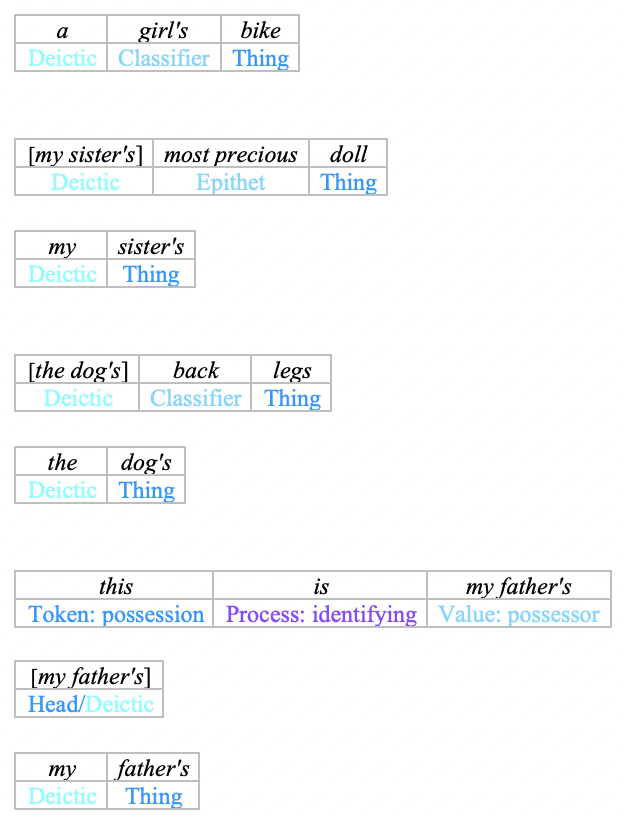
[2] To be clear, one reason why Fawcett's 'cluster' is not recognised in SFL Theory is that it is not necessary. To explain, Fawcett (pp212-3) provides the following examples of 'genitive' cluster:

  • a girl's bike (glossed as 'a bike that is suitable for a girl'),
  • my sister's most precious doll, and
  • the dog's back legs;

and the following example of a name cluster:

  • This is my father's
SFL Theory provides the following analyses:


These will be discussed in more detail in the examination of Sections 10.2.10 to 10.2.12, but, for the moment, note the difference in function between Fawcett's first example (Classifier) and the other three (Deictic realised by embedded nominal group).

Friday, 6 November 2020

Fawcett's Rank Scale Of Functions

Fawcett (2010: 190-1):
The closest that it is possible to come to the 'rank scale' concept in the theory to be described here is to extract from a wider, probabilistic set of statements (which we shall come to in Section 11.2 of Chapter 11) a statement that the various classes of cluster always fill elements of groups (though they are in fact virtually limited to one class of group, i.e., the nominal group), and that groups quite frequently fill elements of clauses (though they also frequently fill elements of every class of group and cluster, and there is one class of group — the quantity group — which fills elements of groups very much more frequently than it fills an element of the clause). Or we might take a different approach and, ignoring the cluster, we might say that, for each word in a text that is being analysed, there is a fairly good possibility that it will be functioning as an element in a group (though many high frequency words such as forms of be function directly as elements of clauses), and also that, if one has identified a group, there is a fairly good possibility that it is functioning as an element of a clause (though many groups do not).

However, these heavily hedged statements are as far as one can go, in the present theory, in trying to state generalisations about the syntax of English in 'rank-like' terms. Notice, moreover, that we cannot turn such statements on their head and say, in the manner of "Categories", that clauses "consist of' groups and groups "consist of' clusters or words, because in the present model it is only some elements of clauses that can be filled by groups; it is only a very few elements of groups that are filled by a cluster (see Section 10.2.12); and it is only some elements of groups that are always expounded by words. (In any case, in the present theory we would not wish to say that groups "consist of' words, because the phenomena typically described as "words" are treated as a type of 'item', and so not as 'units'. See the discussion of this point in Section 10.5.) Thus, while some of the phenomena that originally gave rise to the concepts of a 'rank scale' of 'units' have their place in the new theory, the concept of the 'rank scale' itself plays no part in it.


Blogger Comments:

[1] To be clear, this demonstrates that Fawcett is operating with a rank scale of constituency, but one which involves internal inconsistencies and which violates the principle of exhaustiveness. Halliday & Matthiessen (2014: 84):
The general principle of exhaustiveness means that everything in the wording has some function at every rank (cf. Halliday, 1961, 1966c). But not everything has a function in every dimension of structure; for example, some parts of the clause (e.g. interpersonal Adjuncts such as perhaps and textual Adjuncts such as however) play no role in the clause as representation.

[2] To be clear, Fawcett's 'item' includes both 'word' and 'morpheme', and is said to lie 'outside syntax' in his model of syntax. Fawcett (p266):

The third of the three major categories in the present theory of syntax (with 'unit' and 'element') is the item. This term includes both 'word' (in its traditional sense) and 'morpheme'. Strictly speaking, the concept of 'item' lies outside syntax, since items are a different manifestation of meanings at the level of form from syntax.

Moreover, the 'item' is itself related to a rank scale of functions, on which 'element' is the lowest rank. Fawcett (p266):

In the present theory of syntax, the lowest syntactic category on each branch of the tree in a tree diagram representation of a sentence is an element (e.g., the head of a nominal group). And each such lowest element is expounded by an item — or as we shall see shortly, by items (in the plural).

That is, Fawcett's model also applies a model of formal constituency (rank scale) to functions (e.g. head of a nominal group), despite Fawcett denying that a rank scale is a component of the theory.

Tuesday, 3 November 2020

The Topmost Unit On A Scale That Is Not A Rank Scale

 Fawcett (2010: 190n):

¹ In other words, the topmost unit in a representation of syntax is always a clauseeven though the topmost unit in a given text-sentence may appear to be a nominal group because of ellipsis.


Blogger Comments:

To be clear, if the clause is the topmost unit, and a nominal group is not the topmost unit, then there is a scale on which there are higher and lower units. That is, despite Fawcett's claims, his model makes use of a rank scale — though inconsistently, as will be seen.

Sunday, 1 November 2020

A Rank Scale That Is Not A Rank Scale

 Fawcett (2010: 189-90):

One way in which a clause may be said to be a 'higher' unit than the others — as the 'rank scale' concept predicts it to be — is the fact that the unit that is shown as the 'highest' on the page in any tree diagram representation of a text-sentence is always the clause.¹ In a generative SF grammar, provision for this fact is built into the probabilities on the features in an early system in the overall network, so ensuring that a clause is always generated first. However, we may note that the informal summary of clause syntax for text analysis purposes shown in Appendix B shows that a clause is the only unit that can fill the "element" of "sentence", and this fact is given to the computer parser of texts as a relevant part of its knowledge of syntax. However, this is a fact about clauses in relation to all other units, and on its own it does not constitute evidence that there is a 'rank scale' of units in the "Categories" sense of the term.


Blogger Comments:

[1] To be clear, the rank scale does not "predict" that the clause is a higher unit than the others. The rank scale is a way of modelling constituency, and what makes the clause the highest unit, in this model, is the fact it alone is not a constituent of some other unit. A tree diagram merely represents this fact. Halliday (2002 [1961]: 43):
The units of grammar form a hierarchy that is a taxonomy. To talk about any hierarchy, we need a conversational scale; the most appropriate here might seem that of size, going from “largest” to “smallest”; on the other hand size is difficult to represent in tables and diagrams, and may also trap one into thinking in substantial terms, and a vertical scale, from “highest” to “lowest”, has advantages here. For the moment we may use both, eventually preferring the latter. The relation among the units, then, is that, going from top (largest) to bottom (smallest), each consists of one, or of more than one, of the unit next below (next smaller). The scale on which the units are in fact ranged in the theory needs a name, and may be called rank.
[2] To be clear, Fawcett's set of procedures for clause generation is inconsistent with the theory he is claiming to be developing: Halliday's superseded theory of Scale & Category Grammar. Halliday (2002 [1961]: 42):
In this view of linguistics description is, as already emphasised, a body of method derived from theory, and not a set of procedures. This has one important consequence. If description is procedural, the only way of evaluating a given description is by reference to the procedures themselves: a good description is one that has carried out the right procedures in the right order, but for any more delicate evaluation external criteria have to be invoked. Moreover, every language has to be treated as if it was unknown, otherwise procedural rules will be violated; so the linguist has to throw away half his evidence and a good few of his tools.
A theory on the other hand provides a means for evaluating descriptions without reference to the order in which the facts are accounted for. The linguist makes use of all he knows and there is no priority of dependence among the various parts of the description. The best description is then that which, comprehensiveness presupposed, is maximally grammatical: that is, makes maximum use of the theory to account for a maximum amount of the data.

[3] As this clause demonstrates, Fawcett's model is concerned with text generation by computer, not with language as spoken or written by humans.

[4] This is misleading. As Appendix 2 (pp306-7) demonstrates, Fawcett's model includes the following units, all of which are, in effect, constituents of the clause:

  • nominal group,
  • prepositional group,
  • quality group,
  • quantity group, and
  • genitive cluster.
That is, Fawcett's model has a 2-level rank scale, in the "Categories" sense (see [1]), in all but name.